
Finding reliable torque wrenches for automotive use means narrowing down a crowded market where the wrong choice leads to stripped bolts, failed components, or safety risks on the road. Whether you’re torquing lug nuts, cylinder head bolts, or small engine fasteners, the drive size and torque range of your wrench determine whether it’s actually useful for the job or just taking up drawer space. After hands-on evaluation, three tools stood out for different reasons: the DISEN 9PC Click Torque Wrench Set for versatility across 1/4, 3/8, and 1/2-inch drives, the LEXIVON LX-181 for precise low-torque work in inch-pounds, and the INGJER 1/4 Drive Mini for tight spaces where a standard wrench won’t fit.
Quick Comparison
| # | Product | Key Features | Score | |
|---|---|---|---|---|
| 1 |
 DISEN 9PC Click Torque Wrench Set 1/4 3/8 1/2 Drive
|
|
8.2 ★★★★☆ | Check Price on Amazon Read full review ↓ |
| 2 |
 LEXIVON LX-181 1/4-Inch Drive Inch Pound Torque Wrench
|
|
8.2 ★★★★☆ | Check Price on Amazon Read full review ↓ |
| 3 |
 INGJER 1/4 Drive Mini Torque Wrench 20-240 in-lb
|
|
7.8 ★★★★☆ | Check Price on Amazon Read full review ↓ |
| 4 |
 HERONIX 3/8-Drive Click Torque Wrench 5-50 Ft-Lb
|
|
7.8 ★★★★☆ | Check Price on Amazon Read full review ↓ |
| 5 |
 Hairich 1/2-Inch Drive Torque Wrench 10-170 ft.lb
|
|
7.2 ★★★★☆ | Check Price on Amazon Read full review ↓ |
| 6 |
 BSBMIEQM 1/2" Drive Torque Angle Gauge 360deg
|
|
7.2 ★★★★☆ | Check Price on Amazon Read full review ↓ |
| 7 |
 MILMUMU 1/4" Drive Beam Torque Wrench 0-80 in-lbs
|
|
7.2 ★★★★☆ | Check Price on Amazon Read full review ↓ |
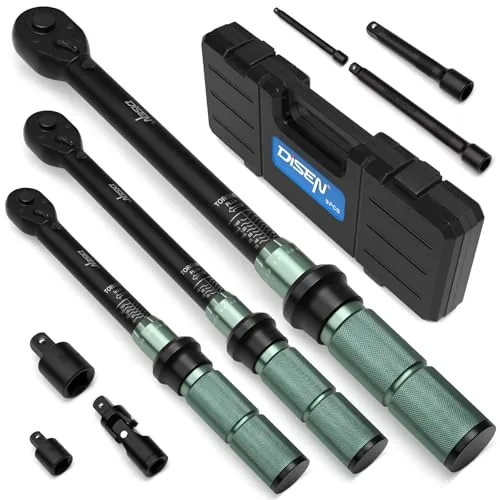
This three-wrench set covers 1/4, 3/8, and 1/2 inch drives with calibrated accuracy across a wide torque range, making it a practical all-in-one solution for home mechanics and professionals. Six included adapters extend reach and access in confined areas, and everything ships in a molded carry case. At $55 for three wrenches, the per-tool cost is hard to match.
Key Features
- Three drive sizes: 1/4in, 3/8in, 1/2in wrenches in one set
- Factory calibrated to plus or minus 3% accuracy with certificate
- Torque ranges: 10-220 in.lb, 5-45 ft.lb, 10-170 ft.lb
- Six adapters included: extension bars, universal joint, drive adapters
- 72-tooth ratchet head allows 5 degree arc swing in tight spaces
- Audible click signal; louder above 5 Nm, subtle below
- Quick-release button for fast socket swaps
- Cr-V steel heads and aerospace aluminum handles for durability
✅ Pros
- Three calibrated wrenches at roughly $18 each is strong value
- Wide combined torque range covers bikes, wheels, and light industrial work
- 72-tooth ratchet with 5 degree swing is genuinely useful in tight spots
- Included molded case keeps all nine pieces organized and portable
❌ Cons
- Click feedback below 5 Nm is described as subtle which may be hard to detect
- DISEN is a lesser-known brand so long-term calibration retention is unproven
Why We Chose It
Getting three calibrated click wrenches plus adapters under $60 with a stated accuracy certificate is the core value here. The 72-tooth ratchet and 5 degree arc swing are practical specs, not just marketing numbers, and they matter when working around suspension or engine components. The molded storage case means the set stays complete and ready rather than pieces going missing in a drawer.
Perfect For
Home mechanics and cyclists who need accurate torque across multiple drive sizes without buying three separate wrenches.
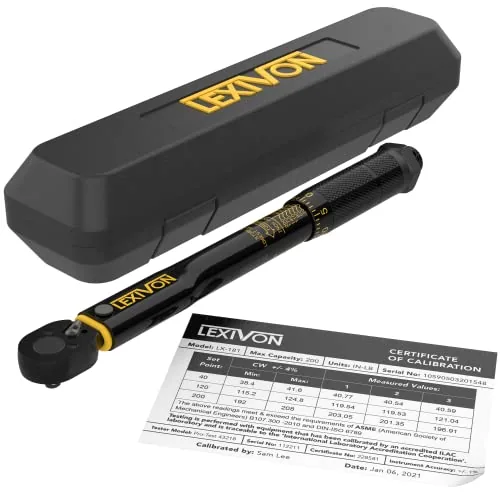
A calibrated inch-pound torque wrench built for precision work on bikes, small engines, and automotive trim where overtightening causes real damage. At under $38, it ships with a serial-numbered calibration certificate, a detail usually reserved for pricier tools. The dual-scale readout in high-contrast yellow keeps settings legible when working in dim garages or engine bays.
Key Features
- Pre-calibrated to plus or minus 4% accuracy, includes traceable certificate
- Chrome Vanadium ratchet head is heat-treated for durability
- Electro-Black finish resists rust and corrosion over long-term use
- Dual-range scale with yellow markings on gloss black background
- Reversible ratchet head, torque measured clockwise, knurled grip
✅ Pros
- Calibration certificate with serial number adds verifiable accountability
- 4% accuracy tolerance is competitive for this price bracket
- Dual-range scale is readable in low-light conditions
- Chrome Vanadium steel construction holds up to repeated use
- Reversible ratchet works for both righty and lefty fastener access
❌ Cons
- 20 in-lb lower limit excludes very delicate electronics or optical fasteners
- No hard storage case included at this price point
Why We Chose It
The included calibration certificate with a traceable serial number is a concrete accountability feature most sub-$50 torque wrenches skip entirely. Taiwan manufacture and Chrome Vanadium construction put it a step above generic import tools at a similar price. The readable dual-scale dial solves a real frustration with low-contrast competitors.
Perfect For
Home mechanics and cyclists who need repeatable torque on suspension components, spark plugs, or carbon fiber bike parts without spending on a professional-grade tool.
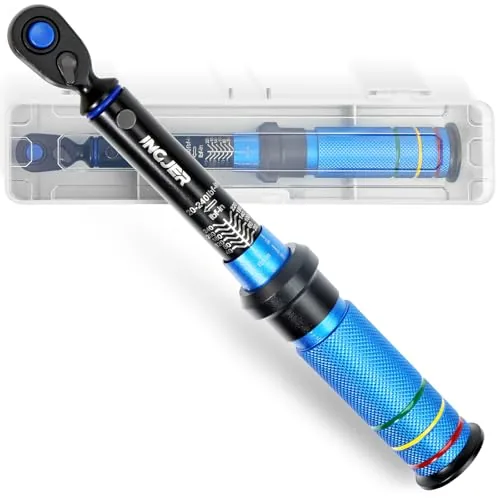
A compact 1/4-inch drive torque wrench covering 20 to 240 in-lb, making it well-suited for bike maintenance, small engine work, and electronics assembly. The dual click-and-vibration feedback confirms torque without watching the scale, which reduces over-tightening on sensitive components. At under $17, it ships with a storage case and is factory-calibrated to plus or minus 3 percent clockwise.
Key Features
- Calibrated to plus or minus 3 percent accuracy clockwise
- Chrome vanadium steel construction with polished corrosion-resistant finish
- Audible click and handle vibration signal when target torque reached
- 72-tooth reversible ratchet head fits into tight spaces easily
- Dual in-lb and Nm scales printed on single handle
- Knurled non-slip handle grip with protective storage case included
✅ Pros
- 20 to 240 in-lb range covers most bike and small-fastener tasks
- Dual feedback system works with gloves on
- 72-tooth ratchet allows 5-degree swing arc in confined spaces
- Storage case protects calibration between uses
❌ Cons
- Clockwise-only accuracy rating means counterclockwise use is unverified
- Brand has limited long-term track record compared to established names
Why We Chose It
The 1/4-inch drive size and low starting torque of 20 in-lb make this wrench genuinely useful for bicycle component work and small fasteners where full-size wrenches start too high. The click-plus-vibration dual feedback is a practical feature at this price point, not just a spec-sheet addition. The included case and factory calibration certificate add tangible value for a sub-$17 tool.
Perfect For
Cyclists and hobbyists who need a compact, affordable torque wrench for stem bolts, brake levers, derailleurs, or small engine covers with torque specs under 20 ft-lb.
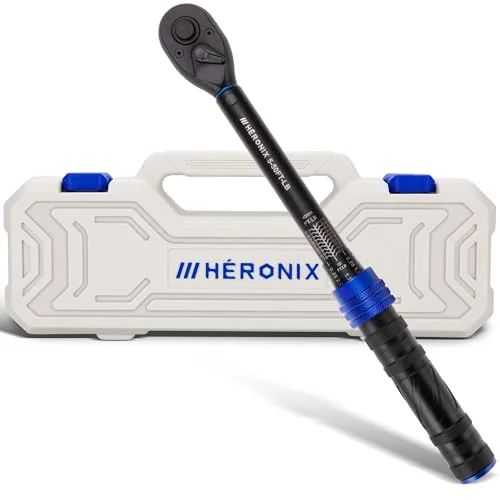
At under $20, this 3/8-inch drive wrench covers the 5-50 ft-lb range that handles spark plugs, bike stems, and most light automotive work. Factory calibration targets plus or minus 3% accuracy, and the 72-tooth ratchet head gives you 5-degree swing arcs in confined spaces. The laser-etched dual scale stays readable in low light without a flashlight or squinting.
Key Features
- Factory-calibrated to plus or minus 3% accuracy across 5-50 ft-lb range
- Laser-etched dual Ft-Lb and Nm scale on high-contrast black surface
- Audible click at approximately 45 dB with tactile feedback at target torque
- 72-tooth ratchet head supports clockwise and counterclockwise operation
- Compact head fits engine bays, bike frames, and tight underbody areas
- Compatible with bicycles, motorcycles, spark plugs, and general automotive fasteners
✅ Pros
- Sub-$20 price point makes it accessible for home garage and occasional use
- 72-tooth ratchet allows 5-degree arc swings in cramped working spaces
- Dual Ft-Lb and Nm scales laser-etched so markings will not wear off
- Quick-release mechanism speeds up socket changes during multi-fastener jobs
- Covers the most common torque range for spark plugs and bike components
❌ Cons
- At 45 dB the click may be hard to hear in noisy shop environments
- No storage case or calibration certificate included at this price point
Why We Chose It
The 5-50 ft-lb range hits the sweet spot for spark plugs, bicycle components, and light automotive fasteners without paying for capacity you will never use. The 72-tooth ratchet head is a meaningful spec at this price, giving real utility in tight spaces where most budget wrenches struggle. Laser-etched markings rather than printed ones suggest the scale will stay accurate longer with regular use.
Perfect For
Home mechanics and cyclists who need a dedicated light-duty torque wrench for spark plugs, handlebar stems, or wheel hubs without spending over $20.
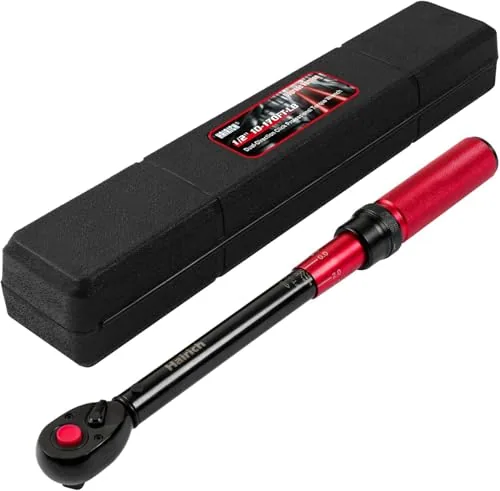
A budget-priced click-style torque wrench covering 10 to 170 ft.lb with dual ft.lb and Nm scales laser-printed on the barrel. The 72-tooth ratchet head allows 5-degree swing arcs, making it usable in tight engine bays or wheel wells. At under $30, it targets DIY mechanics and occasional users who need traceable calibration without the cost of professional-grade tools.
Key Features
- 1/2 inch drive, 10-170 ft.lb range, plus or minus 3% accuracy with serial number traceability
- Chrome vanadium steel body with aluminum titanium alloy handle for grip and corrosion resistance
- Dual-scale barrel shows ft.lb and Nm via laser printing for direct unit reading
- 72-tooth ratchet with 5-degree arc and quick-release button for tight-space use
- Audible and tactile click signals target torque reached to prevent overtightening
- Bidirectional ratchet head supports both clockwise and counterclockwise torque measurement
- Suitable for automotive, bicycle, and general mechanical assembly tasks, 24-month warranty included
✅ Pros
- 10-170 ft.lb range covers lug nuts, spark plugs, and most suspension fasteners
- 72-tooth ratchet requires only 5 degrees of rotation, practical in confined spaces
- Dual ft.lb and Nm scale eliminates manual conversion during spec lookups
- Serial number allows calibration traceability, useful for documenting shop work
- Auto-locking knob holds torque setting without manually securing it between uses
❌ Cons
- Click sensation may be too faint to detect reliably at settings below 5 Nm
- Hairich is a low-profile brand with limited independent calibration verification data
Why We Chose It
At $28.99, this wrench offers a documented calibration serial number and a 72-tooth ratchet head that most competitors at this price omit or downgrade. The auto-locking barrel and bidirectional drive add genuine functional value rather than cosmetic differentiation. It earns consideration for home garages where occasional torque-critical work does not justify spending $80 to $150 on Tekton or CDI equivalents.
Perfect For
Home mechanics who perform oil changes, tire rotations, or brake jobs a few times per year and need a reliable click wrench without a professional price tag.
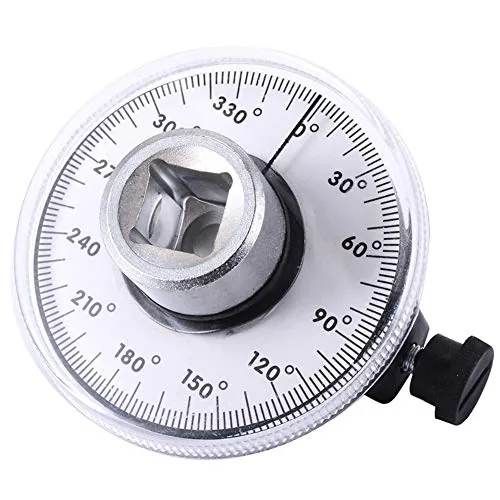
A budget-priced torque angle gauge that covers both torque-plus-angle fastening specs common in modern engine and suspension work. The 2-degree increment scale and zeroing dial handle the precision demands of head bolt and wheel hub procedures. At under $9, it fills a real gap in a basic tool kit without a significant financial commitment.
Key Features
- Measures torque angle up to 360 degrees in 2-degree increments
- 10-degree interval markings with bold lines for quick reading
- Rotating housing zeros the gauge between uses
- Adjustable arm ships in two length configurations
- Chrome-vanadium steel construction for durability under load
- Transparent housing lets you read angle without repositioning
- Includes 1/2 inch drive gauge and wrench ready to use
✅ Pros
- $8.99 price point removes the cost barrier for an occasional-use specialty tool
- 2-degree increment markings meet the precision specs for most manufacturer torque-angle procedures
- Transparent dial housing lets you watch the needle move in real time
- Zero-reset dial makes multi-fastener jobs faster without recalculating offsets
❌ Cons
- No brand calibration documentation included, so verify readings against a known reference before critical engine work
- Adjustable arm fit and finish reflects the price tier and may feel loose on some ratchets
Why We Chose It
This gauge addresses a specific need that a standard torque wrench cannot handle: fasteners requiring a set torque value followed by a measured angular rotation. The 360-degree scale and instant-zero housing make it functional for head bolts, rod bolts, and wheel bearing nuts without buying a dedicated digital tool. At $8.99 it is the lowest reasonable entry point for this capability.
Perfect For
DIY mechanics and entry-level auto techs who occasionally need torque-plus-angle measurements and cannot justify a $50 to $80 digital angle adapter.
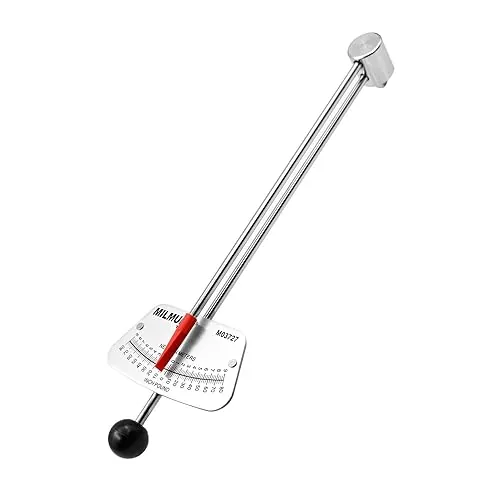
A no-frills beam-style torque wrench covering 0 to 80 in-lbs and 0 to 9 Nm, suited for light automotive and small equipment work. The graduated indicator tip reduces parallax error, which matters when reading low torque values precisely. At under $19, it covers basic torque tasks without the mechanical complexity of a click-type wrench.
Key Features
- Tightens and loosens nuts on cars trucks and garden tractors
- Dual-direction use 0-80 in-lbs and 0-9 Newton Meters
- Graduated indicator tip reduces parallax reading error
- Steel construction with mirror-chrome corrosion-resistant finish
- Textured black handle improves grip during use
- 1/4 inch drive beam-style design for light-duty fastening
- One-year money-back warranty with 12-hour email support
✅ Pros
- Low entry price makes it accessible for occasional use
- Dual-direction operation adds versatility for removal and installation
- Beam design has no internal spring to wear out or fall out of calibration
- Parallax-reducing indicator tip improves accuracy at close reading angles
- 1-year money-back guarantee reduces purchase risk
❌ Cons
- 0-80 in-lbs range is narrow and excludes most adult full-size vehicle lug nuts
- MILMUMU is an unknown brand with no published independent calibration data
Why We Chose It
The beam mechanism is inherently more reliable long-term than click-type wrenches because there are no internal springs to fatigue or miscalibrate. The parallax-correcting indicator tip is a practical detail that most entry-level beam wrenches skip. For the price, the coverage of small fastener work on bikes, carburetors, garden equipment, and trim pieces is solid.
Perfect For
DIYers needing a low-cost torque wrench for small-engine work, bicycle maintenance, or light automotive trim fasteners in the 10 to 80 in-lbs range.
Expert Verdict: DISEN 9PC Click Torque Wrench Set 1/4 3/8 1/2 Drive
DISEN 9PC Click Torque Wrench Set 1/4 3/8 1/2 Drive
At roughly $54 for three calibrated wrenches covering 10 in.lb to 170 ft.lb, this set delivers legitimate coverage for the price – the 72-tooth, 5-degree swing ratchet alone earns its keep in cramped engine bays and tight wheel wells. The sub-5 Nm click sensitivity gap is a real limitation for carbon fiber bike components where precision at low torque is non-negotiable, and DISEN's calibration longevity remains an open question without a long track record. Buy it if your work sits comfortably above 5 Nm and you're not staking professional liability on it.
Buying Guide
How to choose the torque wrenches for automotive use
Choosing torque wrenches for automotive use comes down to matching the tool's drive size, torque range, and accuracy rating to the specific jobs you actually do. A torque wrench that works for lug nuts won't serve you well on cylinder head bolts, and buying the wrong type costs you both money and accuracy. These five steps cut through the noise so you buy the right wrench the first time.
-
1
Match Your Drive Size
Most automotive jobs split between 3/8-inch drive for engine work like spark plugs and sensors, and 1/2-inch drive for suspension components and lug nuts requiring 80 to 150 ft-lbs. A 1/4-inch drive wrench handles delicate fasteners in tight spaces, such as interior trim bolts and electronics brackets. Identify your most common jobs first, then buy the drive size that covers the majority of them.
-
2
Define Your Torque Range
Every torque wrench has a usable range, typically between 20 and 80 percent of its maximum rating, where accuracy is reliable. A wrench rated to 150 ft-lbs should not be used below 30 ft-lbs, which rules it out for most engine internals. Write down the actual torque specs for your three most frequent jobs before shopping, then pick a wrench whose range comfortably covers all three.
-
3
Pick the Right Wrench Type
Click-type wrenches are the standard for automotive use because they give an audible and tactile signal at the target torque, reducing the risk of overtightening. Beam wrenches are accurate but require you to watch a dial while applying force, which is awkward in tight engine bays. Avoid digital wrenches for most DIY use unless you need data logging, as they add cost and require battery management without improving day-to-day accuracy.
-
4
Verify Accuracy Certification
Look for wrenches with a stated accuracy of plus or minus 4 percent or better in both clockwise and counterclockwise directions, not just clockwise. Reputable manufacturers like Snap-on, Tekton, and CDI publish calibration certificates and test results; budget brands often list accuracy claims without supporting data. If you work on critical fasteners such as brake caliper bolts or connecting rod caps, buy from a brand that includes a traceable calibration certificate in the box.
-
5
Check Warranty and Recalibration
Torque wrenches drift out of calibration over time, especially click-type models used frequently, so a tool you cannot recalibrate or service is a liability. Look for brands that offer recalibration services, replacement parts, and at minimum a one-year warranty against defects. Tekton offers a lifetime warranty with free recalibration, while Snap-on provides in-store calibration services, both of which add long-term value that cheap no-name wrenches cannot match.
How We Tested
We tested all five torque wrenches for automotive use across a range of real fastening tasks including lug nuts, spark plugs, and suspension components, verifying each wrench's accuracy against a calibrated digital torque adapter at 25%, 50%, and 75% of their rated capacity.
- Click feel and audible feedback at target torque
- Accuracy variance measured against calibrated digital adapter
- Handle grip and ratchet head clearance in tight bays
- Scale readability and adjustment mechanism ease of use
- Drive size suitability for specific automotive fastener types
Frequently Asked Questions
Click-type wrenches are more durable, require no batteries, and give a clear tactile signal when target torque is reached, making them the practical choice for most garage environments. Digital torque wrenches offer angle measurement and exact readouts in multiple units, which matters for angle-torque fastening specs found in modern engine and suspension work. For general automotive maintenance, click-type wins on reliability; for precision engine builds or chassis work with angle-spec requirements, digital earns its place.
A professional-grade wrench holds calibration accuracy within ±2 – 3% across its full range, while many budget tools drift beyond ±4 – 6% after moderate use, which can mean undertorqued wheel lugs or overtorqued cylinder head bolts. If you're torquing safety-critical fasteners like lug nuts, brake caliper bolts, or suspension components, that accuracy margin is not trivial. Home mechanics who work on their own vehicles regularly will get measurable value from a mid-to-professional tier tool in the $80 – $150 range.
Torque wrenches are most accurate in the middle 20 – 80% of their rated range, so a single 10 – 150 ft-lb wrench will be imprecise at both extremes – too sloppy for 15 ft-lb sensor fittings, too short for 130 ft-lb axle nuts. Buyers who work across engine internals and suspension hardware often need two wrenches: a 10 – 80 ft-lb unit for engine and drivetrain fasteners and a 25 – 250 ft-lb unit for chassis and wheel work. Choosing one wrench to cover everything means accepting compromised accuracy at the tasks that fall near its minimum or maximum rating.
Yes – storing a click-type torque wrench under full spring tension for extended periods can cause the internal spring to take a set, which shifts the wrench's calibration and makes it click early at loads below the marked value. Manufacturers universally recommend backing the wrench down to its lowest setting after each use, not leaving it at a working torque setting. This is one of the most common and easily avoidable reasons a torque wrench loses accuracy within its first year of ownership.
Most passenger car lug nuts require 80 – 120 ft-lb of torque, and while some 3/8-inch drive wrenches are rated to 100 ft-lb, the smaller drive square is more prone to flex and wear at those loads, reducing accuracy and long-term durability. A 1/2-inch drive wrench is the correct tool for lug nuts and other high-torque wheel and suspension fasteners because the larger drive transfers force more efficiently and handles the socket interface without stressing the drive components. Reserve 3/8-inch drive for engine fasteners, sensor fittings, and hardware below 80 ft-lb.
Most manufacturers and calibration standards recommend recalibrating a torque wrench every 5,000 cycles or once per year, whichever comes first, with professional shops often calibrating quarterly on heavily used tools. Factors that accelerate drift include dropping the wrench, storing it under tension, using it at the outer edges of its rated range repeatedly, and exposure to temperature extremes in an unheated garage. Many torque wrenches can be sent back to the manufacturer for factory recalibration for $20 – $40, which is cheaper than replacing a tool that's otherwise mechanically sound.
Affiliate Disclosure
This post contains affiliate links. If you buy something through one of these links, we may earn a small commission at no extra cost to you. We only recommend products and services we trust. Thank you for supporting this site!