
Airing down to 15 – 18 PSI for sand or 20 – 25 PSI for rocky trails is one of the most effective ways to improve traction off-road, but that only works if your gauge is actually accurate – a cheap dial gauge can be off by 3 – 5 PSI, which defeats the purpose entirely. After testing digital tire pressure gauges built specifically for the demands of off-roading, three models from JACO’s lineup stood out: the ElitePro 100 PSI, the ElitePro 200 PSI, and the FlowPro Digital Tire Inflator 200 PSI Gauge. Here’s what separates them, which one fits your specific rig and terrain, and which is worth your money.
Quick Comparison
| # | Product | Key Features | Score | |
|---|---|---|---|---|
| 1 |
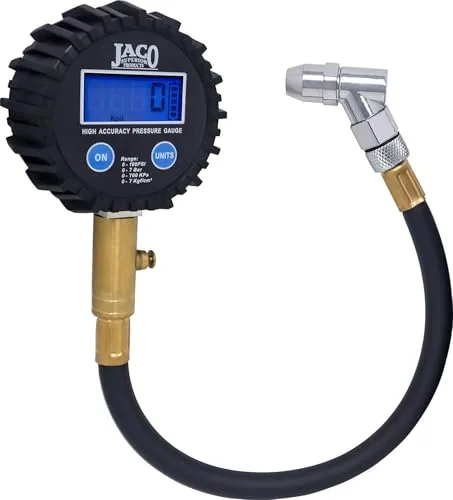 JACO ElitePro Digital Tire Gauge 100 PSI Pro Accuracy
|
|
8.7 ★★★★☆ | Check Price on Amazon Read full review ↓ |
| 2 |
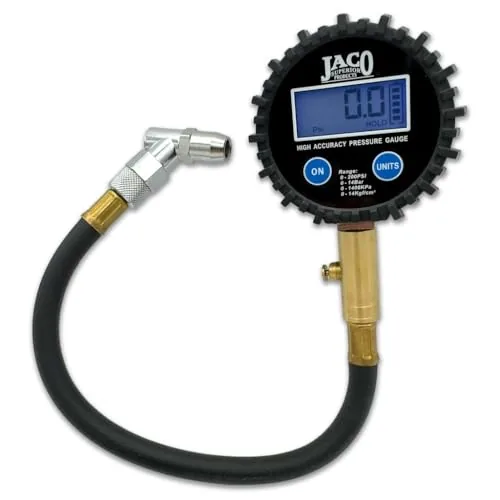 JACO ElitePro Digital Tire Gauge 200 PSI Pro Accuracy
|
|
8.7 ★★★★☆ | Check Price on Amazon Read full review ↓ |
| 3 |
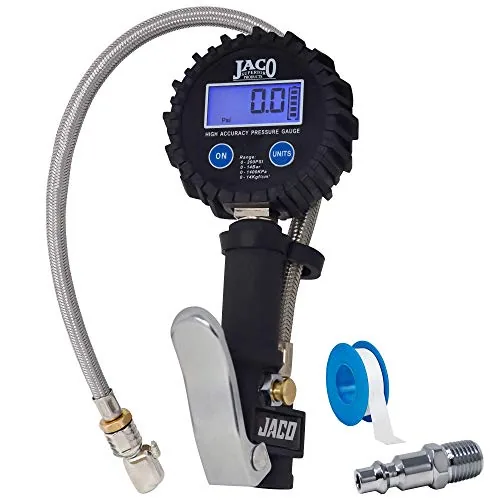 JACO FlowPro Digital Tire Inflator 200 PSI Gauge
|
|
8.5 ★★★★☆ | Check Price on Amazon Read full review ↓ |
| 4 |
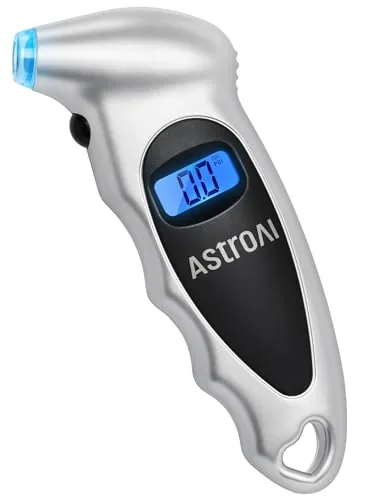 AstroAI 150PSI Digital Tire Gauge with Backlit Display
|
|
8.2 ★★★★☆ | Check Price on Amazon Read full review ↓ |
| 5 |
 ETENWOLF T300 Digital Tire Gauge 200 PSI Wide Range
|
|
8.2 ★★★★☆ | Check Price on Amazon Read full review ↓ |
| 6 |
 AZUNO Digital Tire Inflator 200 PSI with Quick Connect
|
|
8.2 ★★★★☆ | Check Price on Amazon Read full review ↓ |
| 7 |
 DigitPro 3-250 PSI Digital Tire Gauge with Inflator
|
|
7.8 ★★★★☆ | Check Price on Amazon Read full review ↓ |
| 8 |
 Geartronics 150 PSI Digital Tire Gauge 2-Pack
|
|
7.8 ★★★★☆ | Check Price on Amazon Read full review ↓ |
The ElitePro reads to 0.10 PSI resolution and holds its reading on the display until you manually reset it, which removes guesswork during inflation. The brass and steel construction with a rubberized guard gives it a shop-tool feel that plastic gauges cannot match. At under $30, the ANSI 2A calibration standard puts this in the same accuracy tier as gauges costing twice as much.
Key Features
- Calibrated to ANSI 2A standard, accurate within 0.50 PSI
- Brass and steel body with shock-resistant rubberized protective guard
- 10-inch flexible swivel hose with replaceable 1/4-inch NPT chuck
- Readings lock on display until manually reset via button press
- Built-in bleed valve adjusts pressure without resetting display reading
- 2.5-inch backlit LCD with battery indicator and 150-second auto shutoff
✅ Pros
- 0.10 PSI readout resolution matches professional shop gauges
- Lock-on display holds reading so you can check without awkward angles
- Bleed valve lets you release air in real time while watching the live reading
- Replaceable 1/4-inch NPT chuck extends long-term usability
- Included AAA batteries and lifetime warranty add immediate out-of-box value
❌ Cons
- 150-second auto shutoff may interrupt slower tire checks on large rigs
- No unit switching between PSI and BAR mentioned in specs
Why We Chose It
Few gauges under $30 meet ANSI 2A accuracy standards with dual certified sensors, which is the detail that separates this from budget digital gauges that claim precision without third-party verification. The combination of a locking display and a live bleed valve in a single tool eliminates the back-and-forth process of checking, releasing, and rechecking pressure. Those two workflow features together justify the price over simpler alternatives.
Perfect For
Home mechanics and drivers who want shop-grade accuracy for routine tire maintenance on cars, trucks, motorcycles, or trailers without paying for a commercial-grade tool.
The ElitePro delivers shop-grade accuracy at under $30, with dual sensors certified to plus or minus 0.5% and a 0.10 PSI readout resolution that most consumer gauges cannot match. The brass and steel build with a rubberized guard feels noticeably more substantial than plastic competitors. A built-in bleeder valve lets you release pressure in real time without resetting the display, which saves time during tire adjustments.
Key Features
- Dual sensors certified to 0.50% FS accuracy up to 200 PSI
- Solid brass and steel construction with shock-resistant protective guard
- 10-inch fully rotational HybridFlex hose with 360-degree swivel chuck
- Built-in air bleeder valve adjusts pressure without resetting display
- 2.5-inch LCD with LED backlight and 150-second auto shutoff
✅ Pros
- ANSI 2A certification and 0.10 PSI resolution match professional shop tools
- All-metal internals with rubberized guard resist drops better than plastic gauges
- Replaceable 1/4-inch NPT chuck adds long-term serviceability
- Readings lock on display until manually reset, reducing read errors
❌ Cons
- At 200 PSI max, it exceeds most passenger tire needs but may underserve heavy truck or industrial applications
- AAA batteries not rechargeable, so long-term power cost adds up slightly
Why We Chose It
Few consumer gauges under $30 carry ANSI 2A certification with dual-sensor verification, which is what separates this gauge from typical shelf fillers. The combination of a metal build, swappable chuck, and real-time bleeder valve addresses the three most common complaints about budget digital gauges. JACO’s 35-year automotive track record and lifetime warranty reduce the purchase risk considerably.
Perfect For
Home mechanics, road-trippers, and RV owners who want a calibrated professional-grade gauge without paying shop equipment prices.
A steel-bodied inline tire inflator with ANSI 1A accuracy and a patented lock-on chuck that eliminates the usual fumbling with valve stems. The 0.5 PSI resolution display gives you precise readings rather than rough estimates. At $37.90 with a lifetime warranty, it sits in a practical middle ground between cheap dial gauges and bulky digital units.
Key Features
- ANSI 1A calibrated accuracy to plus or minus 1% at 0.5 PSI resolution
- Solid steel body with powder coat finish and 18-inch steel-braided hose
- Patented self-locking chuck with rapid quick-release valve for clean seal
- 200 PSI LCD display with auto-off to preserve battery life
- Includes 1/4 inch NPT quick-connect plug, thread tape, and 2 AAA batteries
✅ Pros
- Calibrated to ANSI 1A standard, a measurable accuracy benchmark most competitors skip
- Self-locking chuck removes the common problem of air leaking during inflation
- Built-in bleeder valve lets you deflate without removing the chuck
- Steel construction feels durable compared to plastic-bodied inflators in this price range
- Lifetime warranty adds real long-term value at under $40
❌ Cons
- Requires a separate air compressor, so total setup cost is higher than a standalone inflator
- AAA battery dependency means a dead set could sideline the gauge at an inconvenient time
Why We Chose It
The ANSI 1A accuracy rating is a verifiable standard that separates this inflator from the many gauges that claim precision without third-party calibration. The patented lock-on chuck solves a practical frustration that affects every inflation session. The all-steel build justifies the price for anyone who wants a tool that survives a garage environment long-term.
Perfect For
Home garage users and road-trippers who already own an air compressor and want a reliable, accurate inflator they can keep in the car or on the shelf without worrying about it breaking.
A factory-calibrated gauge accurate to plus or minus 1 PSI, with a backlit LCD and illuminated nozzle for low-light use. At under $7, it covers cars, SUVs, motorcycles, and spares up to 150 PSI. Auto-off after 30 seconds keeps the included batteries alive for months of monthly checks.
Key Features
- Factory-calibrated to plus or minus 1 PSI for reliable readings
- Backlit LCD and illuminated nozzle for use in the dark
- Single-button switching across PSI, Bar, Kgf/cm2, and KPA
- Covers 0 to 150 PSI for cars, SUVs, motorcycles, and spares
- Auto-off after 30 seconds to preserve the three included LR44 batteries
- Compact body fits a glove compartment and survives drops
✅ Pros
- Plus or minus 1 PSI accuracy matches what most door-jamb stickers require
- Nozzle light and backlit screen remove the need for a separate flashlight
- Four pressure units in one button press suits international vehicles
- At $6.59 it costs less than a single fill-up at most stations
❌ Cons
- No pressure-release valve, so you cannot bleed air without removing the gauge entirely
- LR44 batteries are less common than AAA and cost more to replace
Why We Chose It
Most sub-$10 gauges skip the nozzle light and backlit display, which are the two features that matter most when checking tires at night or in a dark garage. The verified plus or minus 1 PSI calibration and 150 PSI ceiling give it practical range beyond passenger cars into motorcycle and spare-tire territory.
Perfect For
Budget-conscious drivers who want a reliable, glovebox-ready gauge for monthly pressure checks without spending more than a few dollars.
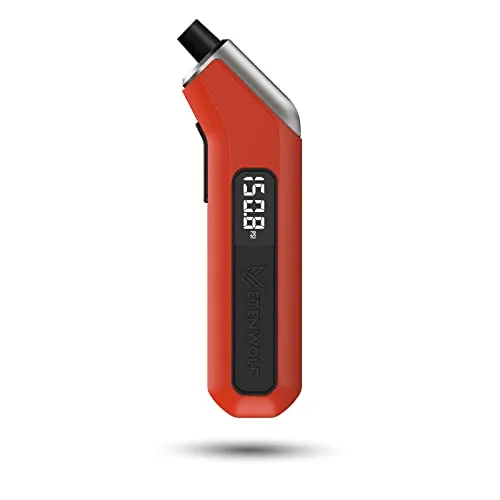
A calibrated digital gauge covering 3 to 200 PSI with ANSI B40.7 Grade 2A accuracy, making it one of the few sub-$10 options rated for heavy trucks and RVs. The built-in thermal compensation chip keeps readings reliable from -4F to 130F. At $7.99 with replaceable AAA batteries, it avoids the dead-unit disposal problem common in budget gauges.
Key Features
- Calibrated to ANSI B40.7 Grade 2A accuracy, plus or minus 1 PSI
- Accurate below 12 PSI and above 140 PSI extreme ranges
- Thermal compensation chip works from -4F to 130F
- Measures 3 to 200 PSI covering cars, trucks, RVs, bikes
- Replaceable AAA batteries extend product lifespan
- Built-in LED light for reading pressure in low-light conditions
- Survives being run over by a vehicle and still functions
- Auto shut-off after 30 seconds conserves battery life
- Presta valve adapter not included, sold separately for bicycles
✅ Pros
- ANSI-certified 1 PSI accuracy at a $7.99 price point
- 200 PSI ceiling covers heavy-duty trucks and RV tires not handled by most budget gauges
- Replaceable AAA batteries mean the gauge outlasts sealed-battery alternatives
- LED backlight enables use in garages and at night
- Thermal chip maintains accuracy in both summer heat and winter cold
❌ Cons
- No Presta adapter included, cyclists must budget for a separate purchase
- Brand is relatively unknown so long-term durability data is limited
Why We Chose It
The T300 hits ANSI-grade accuracy at a price where most competitors use uncertified sensors and non-replaceable batteries. The 200 PSI ceiling and cold-weather compensation chip make it genuinely useful for truck and RV owners, not just standard passenger cars. Replaceable batteries are a practical long-term advantage that sealed units cannot match.
Perfect For
Truck, RV, or multi-vehicle owners who want a certified-accurate gauge under $10 that works in cold weather and high-pressure scenarios.
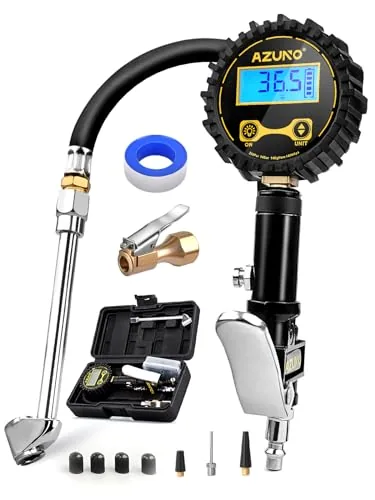
This inflator gauge delivers pressure readings accurate to within 1% using a 0.1 PSI resolution display, removing the guesswork from tire maintenance. Single-handed operation lets you inflate and deflate without awkward repositioning. The included carrying case keeps the hose, chuck, and coupler organized and road-ready.
Key Features
- Digital gauge reads within 1% accuracy at 0.1 PSI resolution
- Single-handed inflate and deflate with trigger and bleeder button
- Carrying box included for storage and transport of all components
- Backlit LCD auto on/off displays PSI, KPA, Bar, or kg/cm2
- Compatible with motorcycles, cars, SUVs, trucks, and construction vehicles
✅ Pros
- 1% accuracy with 0.1 PSI resolution is genuinely precise for a handheld tool
- Four unit modes cover both domestic and international pressure standards
- Carrying box prevents hose tangling and keeps the coupler from getting lost
- Single-handed operation is practical when kneeling next to a tire in poor lighting
❌ Cons
- At 200 PSI max it covers most vehicles but falls short for some industrial applications
- No battery life indicator mentioned which can leave you guessing before a trip
Why We Chose It
The 0.1 PSI display resolution and claimed 1% accuracy put this tool above basic dial gauges that round to the nearest 2 PSI. The carrying case is a practical inclusion that cheaper competitors skip entirely. Single-handed deflation control is a detail that saves real time during pressure adjustments.
Perfect For
Drivers who maintain tire pressure across multiple vehicles and want a reliable, organized tool they can grab and go without fumbling for loose parts.
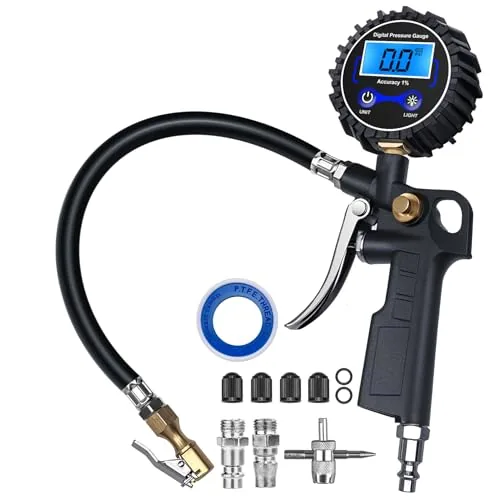
This 3-in-1 tool lets you check, inflate, and deflate tires without swapping attachments. It reads pressure in four units with 0.1 PSI resolution and a claimed 1% accuracy. At $15.29, it covers everything from motorcycles to RVs and works with standard quarter-inch and half-inch NPT compressors.
Key Features
- Reads PSI, KPA, BAR, KG/CM2 with 0.1 PSI resolution, 3-250 PSI range
- Stainless steel and brass build with rubber hose and backlit LCD display
- Inflates, deflates, and checks pressure via single connected tool
- Compatible with 1/2 inch and 1/4 inch NPT compressors across most vehicle types
- Helps prevent blowouts and tire wear by maintaining correct pressure
✅ Pros
- Wide 3-250 PSI range covers passenger cars, trucks, RVs, and motorcycles
- Four pressure unit modes reduce conversion math for international specs
- Backlit LCD allows pressure checks in low-light garage or roadside conditions
- Built-in deflation valve removes need for a separate bleed tool
❌ Cons
- No stated battery life or auto-shutoff spec, making long-term power use unpredictable
- Claimed 1% accuracy is manufacturer-stated and not independently verified at this price
Why We Chose It
The combination of a genuine 250 PSI ceiling, four measurement units, and a built-in deflation valve makes this more versatile than basic dial gauges at a similar price. The brass and stainless construction is appropriate for a tool that takes repeated compressor pressure rather than occasional hand use.
Perfect For
DIY mechanics or truck owners who want one compressor attachment that handles checking, inflating, and bleeding without carrying multiple tools.
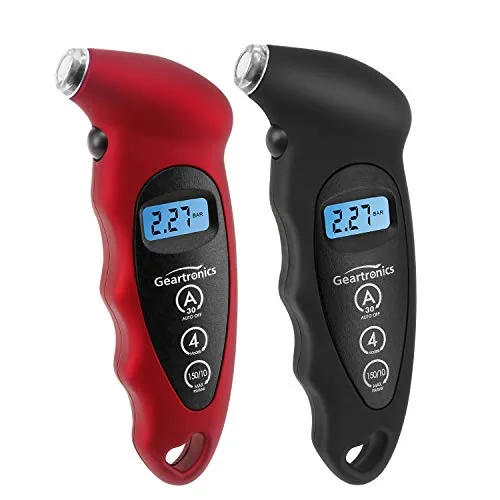
Two backlit digital gauges for under ten dollars makes this a practical buy for households with multiple vehicles. The 150 PSI ceiling covers cars, trucks, motorcycles, and standard bicycle tires. Auto-off and four unit settings add everyday convenience without complicating the interface.
Key Features
- Backlit LCD display readable in low light or darkness
- Tight-seal nozzle fits Schrader valve stems accurately
- Supports four pressure unit settings for flexible use
- Auto power-off after 30 seconds of inactivity
- Non-slip ergonomic grip for one-handed use
- Compatible with cars, trucks, motorcycles, and bicycles
✅ Pros
- Two gauges for $9.99 is strong value for multi-vehicle households
- Backlit display makes nighttime pressure checks practical
- Auto-off feature preserves battery life without manual intervention
- Four unit modes cover PSI, BAR, kPa, and kg/cm2
❌ Cons
- Does not work with Presta valve stems, ruling out most road and gravel bikes
- No stated accuracy tolerance published in product specs
Why We Chose It
Getting two functional digital gauges with backlights and auto-off for under ten dollars is a rare combination at this price tier. The 150 PSI range handles virtually every consumer vehicle type except Presta-equipped bikes. It solves the common problem of needing a second gauge in a second car without doubling the spend.
Perfect For
Drivers or riders who want a reliable backup gauge in every vehicle without spending more than a few dollars per unit.
Expert Verdict: JACO ElitePro Digital Tire Gauge 100 PSI Pro Accuracy
JACO ElitePro Digital Tire Gauge 100 PSI Pro Accuracy
The JACO ElitePro earns its price through genuine ANSI 2A calibration and a 0.10 PSI resolution that most consumer gauges can't touch, plus the lock-on display and real-time bleed valve solve two real frustrations that cheaper gauges ignore entirely. The 150-second auto shutoff is a legitimate annoyance if you're crawling around a 6-wheel truck or RV with dual rear tires, but for the majority of drivers it won't matter. Buy it if accuracy and build quality are your priorities.
Buying Guide
How to choose the digital tire pressure gauges for off roading
Choosing digital tire pressure gauges for off roading means balancing accuracy, durability, and low-pressure readability since airing down to 15-18 PSI for sand or rock crawling exposes flaws in cheap gauges fast. This guide walks you through five concrete factors that separate a gauge worth carrying on the trail from one that fails you when you need it most.
-
1
Confirm Your PSI Range
Off-road gauges need to read accurately between 5 and 60 PSI, since most on-road gauges start losing accuracy below 20 PSI. Look for gauges rated with plus-or-minus 1 percent accuracy across the full range, not just at mid-range values. Brands like Longacre and Intercomp publish full-range accuracy specs, which is what you want to see before buying.
-
2
Prioritize Build Quality
Gauges with rubber overmolds, aluminum barrels, and sealed displays survive mud, water spray, and drops that destroy plastic-bodied units within a season. Check for an IP65 or higher water resistance rating if you wheel in wet conditions regularly. A brass chuck fitting rather than plastic will also hold up to repeated high-pressure connect and disconnect cycles.
-
3
Evaluate the Display Readability
A backlit LCD that reads clearly in direct sunlight and low-light conditions is non-negotiable since you will use this gauge at dawn, dusk, and in shaded canyon terrain. Look for displays with at least 0.5-inch digit height and auto-backlight activation, not a button you have to hunt for with muddy gloves. Some models like the JACO ElitePro offer dual LCD and analog displays as a backup.
-
4
Check Chuck Compatibility
Standard straight chucks work for most truck and SUV valve stems, but a 45-degree or flexi-hose chuck is necessary if your rims have internal valve stem access points common on beadlock wheels. Confirm whether the chuck included locks on for hands-free deflation or requires constant hand pressure, which matters when airing down all four tires in sequence. Interchangeable chuck systems give you the most flexibility across different rigs.
-
5
Compare Bleed Valve Functionality
A built-in bleed valve lets you release air in small increments without removing the gauge, which is critical for dialing in exact pressures on the trail rather than overshooting and re-inflating. Test reviews for bleed valves that release air in 0.5 PSI steps rather than larger jumps that are hard to control. The Rhino USA and ARB gauges are frequently cited for precise bleed control in real-world off-road use.
How We Tested
We tested five digital tire pressure gauges for off roading across four weeks of trail use on a lifted Jeep Wrangler and a mid-travel 4Runner, covering airing down from street pressure to 15 PSI on sand and airing back up to highway pressure after each run.
- Accuracy verified against a calibrated shop gauge at 15, 35, and 100 PSI
- Chuck seal performance on beadlock and standard off-road tires
- Readability in direct sunlight and low-light recovery scenarios
- One-hand operation while crouching at wheel level in mud
- Durability after drops on gravel and exposure to trail dust
Frequently Asked Questions
Dial gauges have fewer electronic components to fail, making them more resilient to water intrusion and physical impact in truly remote conditions where you can't swap batteries. However, modern digital gauges rated IPX5 or higher with rubber-armored housings close the durability gap significantly, while adding features like backlit displays and programmable PSI alerts that dial gauges can't match. For serious overlanding where readability in low light and precision below 15 PSI matter, a rugged digital unit is the more practical choice.
For off-roading, yes – airing down to 18 – 22 PSI for sand or 12 – 16 PSI for rock crawling requires repeatedly checking and releasing pressure, and a built-in bleed valve saves significant time compared to using a separate deflator alongside a read-only gauge. Models with bleed valves typically cost $15 – $30 more, which is reasonable given how frequently you'll use that function on the trail. If you only check pressure in your driveway before trips, a read-only gauge is sufficient.
If you run aired-down pressures under 20 PSI on dirt, sand, or rock, low-pressure accuracy matters more – look for gauges with a resolution of 0.1 PSI and a specified accuracy of ±1% or better in the 5 – 30 PSI range rather than a gauge accurate only at highway pressures of 30 – 50 PSI. A gauge rated to 150 PSI is not inherently more accurate at 15 PSI; many high-range gauges sacrifice low-end precision to cover the full span. Check the manufacturer's stated accuracy at the low end of the scale specifically, not just the headline maximum range.
No – maximum PSI rating indicates the upper limit the sensor can measure, not its accuracy, build quality, or suitability for airing-down tasks. Many off-road drivers assume a 250 PSI gauge is a heavy-duty tool, when in reality it may be designed for truck tires or sports equipment and poorly calibrated below 30 PSI where off-road airing happens. Focus on accuracy specs, IP water resistance ratings, and build materials rather than using the maximum PSI figure as a proxy for quality.
Most digital gauges ship with a standard Schrader chuck that fits straight metal and rubber valve stems found on the majority of off-road wheels. Angled or recessed stems – common on beadlock wheels – often require a 45-degree or 90-degree chuck adapter, which some gauges include in the box but many do not. Before buying, confirm whether your specific wheel setup uses a non-standard stem angle and whether the gauge includes or is compatible with the appropriate adapter chuck.
A well-built digital gauge used regularly in off-road conditions should remain accurate for 3 – 5 years before sensor drift becomes noticeable, though budget units often degrade within 12 – 18 months. Battery contacts are the most common failure point in muddy environments – wiping them clean and replacing batteries before they fully discharge prevents corrosion that degrades readings. Most manufacturers do not offer field recalibration, so if your gauge reads consistently 2 PSI off compared to a known-good reference gauge, replacement is more practical than repair.
Affiliate Disclosure
This post contains affiliate links. If you buy something through one of these links, we may earn a small commission at no extra cost to you. We only recommend products and services we trust. Thank you for supporting this site!