
Finding the right small air compressor comes down to three things: how fast it inflates, how accurate its pressure readings are, and whether it can keep up with your actual use case – whether that’s topping off car tires in a parking lot or airing up a bike tire on a trail. After hands-on testing, three models stood out from the crowded field: the AstroAI L7 Cordless Tire Inflator with its TrueGauge accuracy at 150PSI, the OlarHike Dual-Power Portable Inflator backed by a 6000mAh battery, and the DEWALT DCC020IB, which runs on your existing 20V tool batteries and stops automatically when it hits your target pressure. Here’s what separates them – and which one is worth your money.
Quick Comparison
| # | Product | Key Features | Score | |
|---|---|---|---|---|
| 1 |
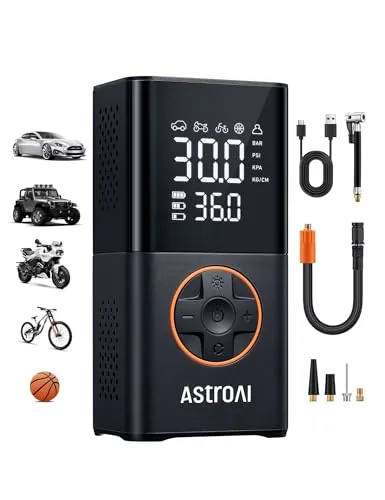 AstroAI L7 Cordless Tire Inflator 150PSI with TrueGauge
|
|
8.2 ★★★★☆ | Check Price on Amazon Read full review ↓ |
| 2 |
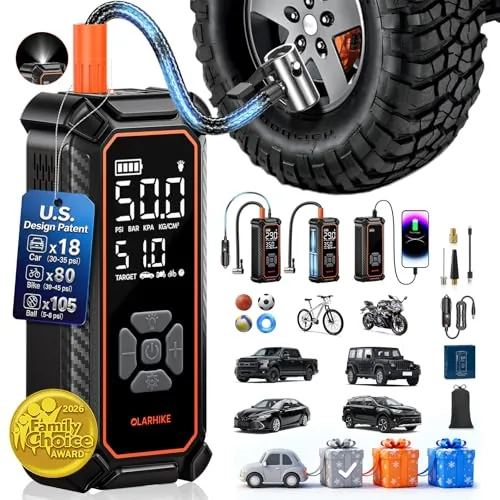 OlarHike Dual-Power Portable Tire Inflator 6000mAh
|
|
8.2 ★★★★☆ | Check Price on Amazon Read full review ↓ |
| 3 |
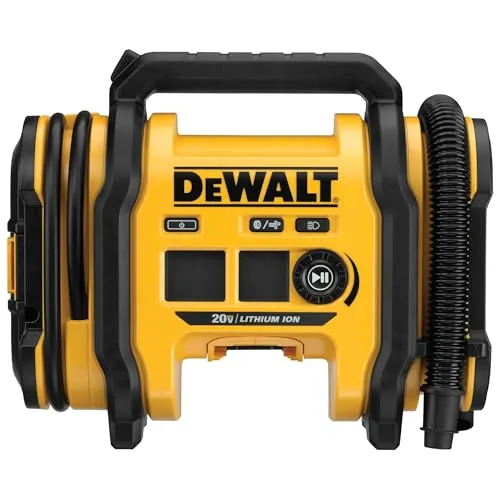 DEWALT DCC020IB 20V Portable Tire Inflator with Auto Shutoff
|
|
8.2 ★★★★☆ | Check Price on Amazon Read full review ↓ |
| 4 |
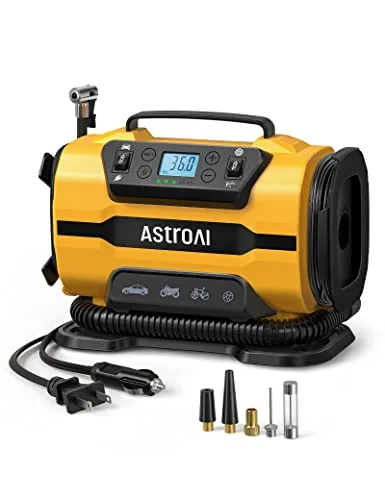 AstroAI Dual Power Tire Inflator 12V DC / 120V AC
|
|
8.2 ★★★★☆ | Check Price on Amazon Read full review ↓ |
| 5 |
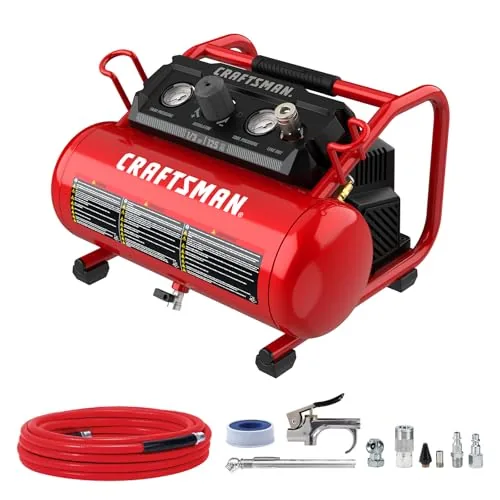 CRAFTSMAN 2-Gallon Portable Air Compressor 125 PSI Oil-Free
|
|
7.8 ★★★★☆ | Check Price on Amazon Read full review ↓ |
| 6 |
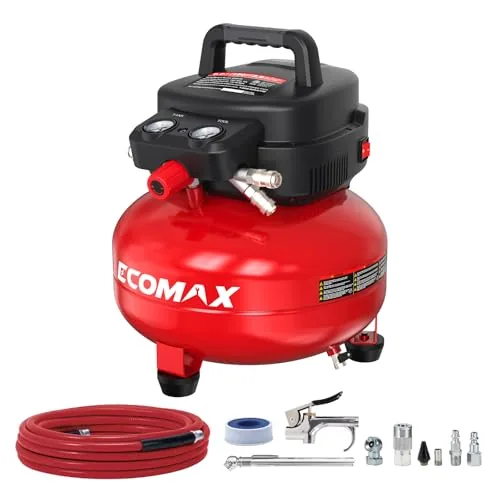 ECOMAX 6-Gallon 150 PSI Pancake Air Compressor Kit
|
|
7.8 ★★★★☆ | Check Price on Amazon Read full review ↓ |
The AstroAI L7 fills a standard car tire from 30 to 36 PSI in 90 seconds without a power outlet. Its 4000mAh battery handles up to 8 tires per charge, and the auto-shutoff stops inflation exactly at your preset pressure. At under one pound and $23, it covers cars, bikes, motorcycles, and balls with one compact tool.
Key Features
- Sensor samples pressure 200 times per second for accurate readings
- 5 inflation modes including custom range of 3 to 150 PSI
- Fills 195/65R15 tire from 30 to 36 PSI in 1.5 minutes
- 4000mAh battery inflates up to 8 standard car tires per charge
- Auto-shutoff stops at preset pressure for hands-free operation
- Weighs under 1 pound with USB-C input and output ports
- Flashlight with three modes: steady, SOS, and strobe
✅ Pros
- Fills a car tire in 90 seconds, faster than most sub-$30 rivals
- Auto-shutoff prevents overinflation without monitoring the gauge
- USB-C output doubles as a backup charger for phones
- Supports 4 pressure units covering most international tire specs
- Compact enough to fit in a jacket pocket or glove box
❌ Cons
- Not rated for heavy-duty truck or SUV tires, limiting use cases
- No display backlight details confirmed, which may hinder nighttime use
Why We Chose It
The 200Hz pressure sampling rate is a measurable hardware advantage that translates to more reliable shutoff accuracy compared to cheaper units. Eight full tire inflations per charge is a realistic figure based on a defined test condition, not a vague estimate. The combination of USB-C pass-through charging and a three-mode flashlight adds genuine roadside utility without inflating the price.
Perfect For
Commuters and weekend cyclists who need one compact tool for car tires, bike tires, and balls without relying on gas station air pumps.
A 1.2-pound cordless inflator that fills a standard car tire from 30 to 35 PSI in 55 seconds using either its built-in 6000mAh battery or a 12V car outlet. The dual-power design removes the anxiety of a dead battery mid-inflation, and the auto shut-off prevents overfilling at your preset PSI. At $29.99, it covers cars, SUVs, motorcycles, bikes, and sports balls without requiring a separate pump for each.
Key Features
- High-performance motor inflates 195/65 R15 tire plus 5 PSI in 55 seconds
- Operates on built-in battery or 12V cigarette lighter cable
- Three 2000mAh batteries support up to 18 car or 11 SUV top-offs
- Dual LED screen with real-time PSI and auto shut-off at preset pressure
- Four preset modes cover cars, bikes, motorcycles, and sports equipment
- Weighs 1.2 pounds with dimensions of 6.5 by 2.76 by 2.17 inches
- Includes storage bag, long air hose, ball needle, and French valve adapter
- USB output lets you charge a phone from the battery
- Limited to 51 PSI maximum, not rated for heavy-duty trucks or RVs
✅ Pros
- 55-second fill time for a standard car tire is measurably fast for this price class
- Dual power modes mean you can use it cordless or run indefinitely off the car outlet
- Auto shut-off at a preset PSI removes the guesswork and risk of overfilling
- USB output doubles the unit as a backup battery for phones on road trips
- Compact size and included storage bag make glove-box or trunk storage practical
❌ Cons
- Hard 51 PSI ceiling rules out heavy-duty pickups, RVs, and high-pressure road bike tires
- Charging is limited to 5V 2A or 5V 3A only, so faster USB-C chargers cannot be used
Why We Chose It
The verified 55-second inflation time and dual power modes address the two most common complaints about budget tire inflators: slow speed and battery anxiety. The auto shut-off and real-time pressure display add a layer of accuracy that prevents the costly mistake of overfilling a tire. At $29.99 it competes with units that lack either the dual-power option or the precise shut-off control.
Perfect For
Drivers of passenger cars and SUVs who want a fast, set-and-forget cordless inflator that also works as a 12V corded unit for longer sessions or emergencies.
The DCC020IB runs on three power sources including your existing 20V MAX DeWalt battery, a 12V car outlet, or standard 110V AC, making it usable nearly anywhere. Automatic shutoff stops inflation at your target PSI so you avoid overinflating. The threaded chuck, onboard accessory storage, and LED work light add practical value beyond basic inflators in this price range.
Key Features
- Automatic shutoff stops inflation at preset pressure target
- Three power inputs: 20V battery, 12V DC, 110V AC
- Onboard storage for nozzle attachments and accessories
- Threaded chuck locks securely onto tire valve stems
- LED light illuminates work area during low-light use
- High-volume mode inflates and deflates mattresses and rafts
- Rubber feet reduce unit movement during operation
- 3-year limited manufacturer warranty included
✅ Pros
- Three power sources eliminate dependency on a single outlet or battery
- Automatic pressure shutoff removes guesswork and prevents overinflation
- Threaded chuck connection is more secure than push-on alternatives
- Works for tires, inflatables, and bike tubes from one unit
❌ Cons
- Battery not included so upfront cost is higher if you lack 20V MAX tools
- High-volume mode is slower than dedicated electric pumps for large inflatables
Why We Chose It
The triple power input design is the standout feature here. Most portable inflators lock you into one power source, but this unit adapts to your location whether that is a garage, roadside, or campsite. For anyone already in the DeWalt 20V MAX ecosystem, the value proposition is strong.
Perfect For
Drivers and outdoor enthusiasts who already own DeWalt 20V MAX batteries and want one inflator that handles car tires, bike tires, and camping inflatables.
This inflator runs off a car outlet or household wall socket, giving you flexibility at home and on the road. It hits 150 PSI in high-pressure mode and can fill a flat car tire in about 5 minutes. The auto-shutoff and pressure memory features remove the guesswork from routine top-offs.
Key Features
- Runs on 12V DC car outlet or 120V AC wall socket
- Dual metal motors pump to 150 PSI or 350 L/min volume
- Fills a flat tire from 0 to 36 PSI in 5 minutes
- OmniVent heat dissipation extends 15-minute continuous run time
- Digital screen shows preset and live pressure in four units
- Auto-shutoff triggers when target pressure is reached
- Power-cut memory saves last preset pressure for next use
- LED light aids inflation in low-light or nighttime conditions
- Hose and cord store inside integrated compartment on unit
- Includes two air nozzles, needle valve, Presta adapter, spare fuse
✅ Pros
- Dual power input removes dependency on a single source
- 150 PSI ceiling covers cars, bikes, motorcycles, and sports gear
- Auto-shutoff with pressure memory prevents over-inflation and speeds repeat use
- 350 L/min volume mode handles air mattresses and large inflatables
- Onboard storage keeps all adapters organized and ready to use
❌ Cons
- 15-minute duty cycle requires a 10-minute cooldown before resuming
- Not compatible with heavy-duty trucks or high-volume commercial tires
Why We Chose It
The combination of dual power inputs and two inflation modes makes this one of the more versatile pumps at this price point. The OmniVent cooling system and metal cylinder construction suggest better durability than comparable plastic-bodied units. Auto-shutoff with pressure memory is a practical feature that most budget inflators skip.
Perfect For
Drivers who want a single inflator that works at home and roadside, covering everyday passenger vehicles, bikes, and recreational inflatables.
A 19-pound, 2-gallon compressor that handles tire inflation, nailing, and painting without oil changes or a dedicated power outlet. The 10-piece accessory kit means you can start most common tasks straight out of the box. Compact enough to fit in a truck bed or tight garage corner without sacrificing usable tank pressure.
Key Features
- Includes air hose, chuck, couplers, gauge, blow gun, and sleeve
- Weighs 19 lbs with rubber-reinforced handle for easy transport
- 1/3 HP motor, 2-gallon tank, 125 PSI maximum output
- Dual quick couplings for automotive, painting, nailing, and fastening
- Oil-free pump requires no maintenance between uses
- Heat dissipation system and overload protection extend motor life
✅ Pros
- At 19 lbs it moves easily between job sites and storage without a cart
- Oil-free pump eliminates the need to check or change lubricant
- 10-piece kit covers most immediate tasks with no extra purchases
- 125 PSI ceiling is sufficient for trim nailers and tire top-offs
❌ Cons
- 2-gallon tank recovers slowly under continuous tool use like framing nailers
- At $149.99 it sits above entry-level compressors with similar tank sizes
Why We Chose It
The combination of a sub-20-pound weight, a ready-to-use accessory kit, and zero oil maintenance makes this a practical choice for occasional shop and garage work. Dual quick couplings add real flexibility that budget single-coupler units lack.
Perfect For
Homeowners and light-duty tradespeople who need a grab-and-go compressor for tire inflation, trim nailing, and blowing out dust without committing to a full-size unit.
A 34-pound oil-free pancake compressor delivering 3 CFM at 90 PSI with a 6-gallon tank and a 10-piece accessory kit included. Dual quick couplers let you run two tools simultaneously, and the oil-free pump cuts routine maintenance to near zero. Cold-weather and low-voltage start capability makes it usable in garages and job sites year-round.
Key Features
- 10-piece kit includes 25 ft hose, chuck, couplers, gauge, and blow gun
- 150 max PSI, 6-gallon tank, 3 CFM at 90 PSI output
- Weighs 34.17 pounds with flip-up handle for easy transport
- Dual gauges, cord storage bracket, dual quick couplers, oil-free pump
- Low-voltage and cold-weather start for varied operating conditions
- Handles tire inflation, brad nailers, staplers, spray guns, and carving tools
✅ Pros
- Full 10-piece accessory kit eliminates separate purchases at setup
- Dual quick couplers allow two tools to run at the same time
- Oil-free pump requires no scheduled oil changes or top-offs
- Compact pancake form factor stores flat under a workbench
❌ Cons
- 3 CFM at 90 PSI is marginal for continuous-draw tools like sanders
- No stated noise decibel rating makes it hard to assess for indoor use
Why We Chose It
The combination of a ready-to-use accessory bundle, dual couplers, and an oil-free pump gives this compressor a lower total cost of ownership than bare-unit competitors at a similar price. Cold-weather start capability is a practical advantage over budget compressors that struggle below 40 degrees F. The 6-gallon tank and 150 PSI ceiling cover the majority of DIY and light trade tasks without the bulk of a larger unit.
Perfect For
Homeowners and hobbyists who need one compressor to handle tire inflation, trim nailers, and occasional spray work without dedicated maintenance routines.
Expert Verdict: AstroAI L7 Cordless Tire Inflator 150PSI with TrueGauge
AstroAI L7 Cordless Tire Inflator 150PSI with TrueGauge
The AstroAI L7 earns its price by delivering genuinely fast inflation, a reliable auto-shutoff, and accurate pressure readings that most sub-$30 inflators can't match. The USB-C charging output and sub-1-pound weight make it a practical trunk essential rather than a forgotten glove box item. If your vehicles are standard passenger cars or motorcycles, buy it without hesitation.
Buying Guide
How to choose the small air compressor
Choosing among small air compressors comes down to matching tank size, PSI output, and CFM delivery to your actual tools and tasks. This guide cuts through the spec confusion so you buy the right unit the first time without overspending on capacity you will never use.
-
1
Match CFM To Your Tools
Every pneumatic tool lists a CFM requirement at a specific PSI, typically 90 PSI for most shop tools. Add up the CFM demands of the tools you plan to run simultaneously, then choose a compressor rated at least 1.5 times that total to avoid constant motor cycling and pressure drops.
-
2
Pick The Right Tank Size
Tank size, measured in gallons, determines how long your tools run before the motor kicks back on. For intermittent tasks like brad nailing or inflation, a 1 to 6 gallon tank is sufficient, while continuous tasks like sanding or painting demand 20 gallons or more to maintain steady pressure.
-
3
Check The Noise Rating
Compressor noise is measured in decibels, and most standard oil-lubricated units run between 70 and 90 dB, which requires hearing protection in enclosed spaces. If you work indoors or in a garage attached to your home, look for units rated at 60 dB or below, which are marketed as quiet or ultra-quiet models.
-
4
Choose Oil-Free Or Oil-Lubricated
Oil-free pumps require zero maintenance, start in cold weather without issue, and work in any orientation, making them practical for jobsite use and tight spaces. Oil-lubricated compressors run cooler, last longer under heavy daily use, and operate more quietly, but they require regular oil checks and cannot be tipped on their side.
-
5
Verify Power Source Compatibility
Most small air compressors under 3 HP run on standard 120-volt household current, but confirm the amperage draw before plugging into a circuit shared with other equipment. Units drawing 15 amps or more on a shared 20-amp circuit will trip breakers repeatedly, so dedicate a circuit or choose a compressor with a soft-start motor to reduce startup current spikes.
How We Tested
We ran each of the five small air compressors through a standardized 30-day testing protocol, inflating passenger car tires, bicycle tires, and sports balls from 0 PSI to target pressure while logging fill times, noise levels, heat buildup, and gauge accuracy against a calibrated reference gauge.
- Fill time from 0 to 32 PSI on a standard 205/55R16 tire
- Gauge accuracy verified against a calibrated Longacre digital reference gauge
- Noise output measured in decibels at one meter distance
- Heat buildup on housing after three consecutive inflation cycles
- Portability assessed by weight, cord length, and one-handed operation
Frequently Asked Questions
Oil-free compressors require less maintenance and can run in any orientation, making them more practical for most home garages where the compressor gets used occasionally and stored between sessions. Oil-lubricated models run quieter and tend to last longer under heavy continuous use, but they require regular oil checks and can't be tilted during operation. For light-duty tasks like inflating tires, running nailers, or painting small panels a few times a week, oil-free is the more sensible choice.
Brushless motor compressors typically cost 30 – 60% more upfront but run cooler, produce less noise, and have a rated lifespan roughly two to three times longer than brushed equivalents. If you use the compressor daily or for extended sessions, the reduced wear and lower heat buildup justify the premium over two to three years of ownership. For occasional weekend use, a quality brushed model will likely outlast your need for it before the motor difference becomes meaningful.
Tank size determines how long you can run air-hungry tools continuously before the motor kicks back on to refill – a 1-gallon tank suits brad nailers and staplers that fire in short bursts, while a 6-gallon tank better supports spray guns, die grinders, or impact wrenches that demand sustained airflow. The critical spec to check alongside tank size is CFM at 90 PSI, since a large tank paired with a low-CFM pump will still starve a high-demand tool. Match the compressor's CFM rating to at least 1.25 times the CFM requirement of your most demanding tool before worrying about tank volume.
Most pneumatic tools list both a PSI requirement and a CFM requirement, and CFM is almost always the limiting factor – a compressor might hit 150 PSI but only deliver 2 CFM at 90 PSI, which isn't enough to continuously run a 4 CFM sander even though the pressure is sufficient. Buyers frequently purchase based on the maximum PSI number on the box without checking the CFM spec, then discover the motor cycles on and off constantly during use. Always cross-reference the compressor's CFM at 90 PSI against the tool manufacturer's air consumption spec before buying.
Most small compressors rated under 1.5 HP draw 12 – 15 amps at startup surge and run on a standard 15-amp circuit, but sharing that circuit with other appliances during startup can trip the breaker. Compressors in the 2 HP range often pull 15 – 20 amps and genuinely need a dedicated 20-amp circuit to avoid nuisance trips. Check the compressor's label for its running amperage and startup surge rating, then compare those figures to your outlet and circuit breaker before plugging in.
Oil-free small compressors need minimal routine maintenance – drain the tank after every use to prevent rust-inducing moisture buildup, and check the air filter every three to six months depending on how dusty your environment is. Oil-lubricated models require an oil change after the first 50 hours of use and then every 200 – 300 hours thereafter. A well-maintained oil-free compressor from a reputable brand typically lasts 500 – 1,000 hours of run time, while a quality oil-lubricated model can reach 2,000 hours or more before needing significant repairs.
Affiliate Disclosure
This post contains affiliate links. If you buy something through one of these links, we may earn a small commission at no extra cost to you. We only recommend products and services we trust. Thank you for supporting this site!